HOURS: TUESDAY - SATURDAY 12-9PM // CLOSED SUNDAYS & MONDAYS
THANKSGIVING EXTENDED HOURS: SUNDAY NOV. 22 11 AM - 5PM
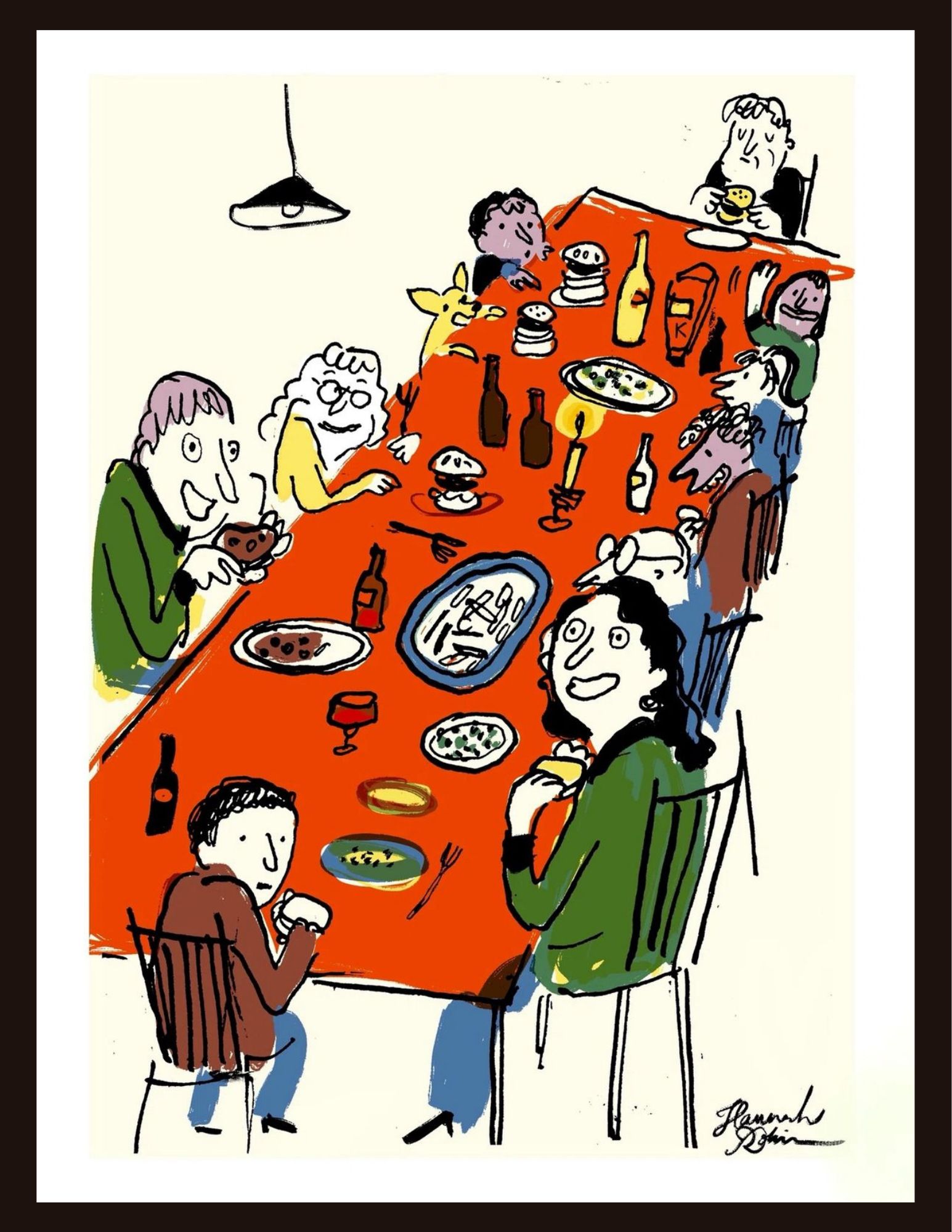
Sometimes reality catches up with us. Not brutally, but through a succession of events, encounters, readings and reflections that, each in their own way, seem to convey the same message to us. Experiences that seem independent of each other end up coming together, responding to each other and, almost without our knowledge, giving rise to a reflection around a common idea. This is precisely what has happened to me in the last few weeks.
A succession of circumstances, with no apparent connection, has come to confirm a desire, almost a need, that I had previously believed to be profoundly personal, but which now seems to me to be a much more universal aspiration, that of finding ourselves, of coming together and, quite simply, of being together. This fundamental need to share a space, a moment, a conversation, this need to meet around the same table.
A few weeks ago, my friend Vincenzo Le, owner of Cicada Coffee Bar, came to visit me in Bonde. He bought a bottle of wine there, without specifying what occasion it was not intended for or the reasons for his choice, and a few hours later he posted a video on Instagram inviting you to take time for yourself, to slow down and to reflect on the importance of reconnecting with yourself and with others. A simple message, but one whose resonance particularly touched me.
Then came two recent publications by my friend, the philosopher Emanuele Coccia, where in "Philosophy of the Home", he explores an idea that seems essential to me, namely that a home is not only defined by its architecture, its walls or its physical space, but above all by the beings who inhabit it, the relationships they build there and the life they share there. As he expresses in a reflection that I particularly remember: "That the home is not a backdrop to our existence but the primary laboratory where we construct the self." In other words, our home is not simply the setting for our existence. It is this living place where our identity is built, where our relationships take shape and where our way of being in the world is invented, day after day. In his other book, "A Treatise on Modern Love", Emanuele Coccia invites us to reflect on an equally fundamental force, that of love. Not only romantic love, but love as a principle of relationship, solidarity and human continuity. This force that, for millennia, has allowed human beings to come together, to care for each other and, perhaps, to preserve what constitutes the very essence of our humanity. An idea as simple as it is profound "If love helped to save humanity yesterday, why can't it still save us today?"
At the same time, in the last few days, I have seen a proliferation of publications around a growing trend, that of pop-up dinners and private chefs at home. Chefs who temporarily leave the traditional kitchens of restaurants to come and cook in private homes, transforming a house into a place of meeting, discovery and sharing for a meal. Beyond the gastronomic experience, this phenomenon seems to me to reflect a deeper aspiration, that of giving back to domestic hospitality, the pleasure of entertaining and the fact of gathering around a table all their meaning.
And then, finally, this morning, a new reading came to bring together all these reflections.
An article from Christina Pickard, published November 2nd 2026 inWine Enthusiast, titled “Family Dinners Are a Lost Art. Bringing Them Back Could Save Our Humanity”.
A title that, on its own, seemed to put into words what all these encounters and readings were trying to make me understand. Because, despite their different approaches, all these publications question, in their own way, the same contradiction of our modern life. We have gradually confused the functional necessity of nourishing ourselves with the profoundly human act of sharing a meal, and eating has become, all too often, a simple transaction with our bodies. A biological necessity to be satisfied, a function to be accomplished, sometimes even a disturbing interruption in a day dedicated to being ever more productive. We eat quickly, sometimes alone, often in front of a screen, between two obligations, two appointments or two notifications. We calculate calories, measure proteins, optimize preparation time and sometimes reduce the meal to its nutritional value alone.
But by dint of wanting to nourish our bodies effectively, haven't we forgotten that the table should also nourish our mind, our emotions and our relationships with others?
For the table is not simply a piece of furniture around which we consume food. It has been, since the origins of our civilizations, one of the most fundamental places in our social construction. It is around a table that we learn to listen, to speak, to exchange, to debate, to confront ideas different from our own. It is there that family histories, traditions, values and sometimes the greatest lessons of our existence are transmitted. It is also where we learn to share, not only bread and wine, but time, attention and, above all, a part of ourselves.
Religious, philosophical and spiritual texts, whatever their origins or beliefs, have borne witness to this importance of gathering for millennia. Beyond the ethical principles, moral rules and social duties that they transmit, we constantly find scenes of meals, celebrations, hospitality and sharing. Bread breaks, wine is poured, words circulate, or teachings are transmitted, alliances are formed, disagreements are discussed and communities are built. The table thus becomes much more than a place where we eat, it becomes a space where we recognize the existence of the other, where the individual accepts, for the duration of a meal, to be part of a whole that goes beyond him. And it is precisely this dimension that seems to me to be threatened today.
How did our modern society, which has never had so many means of communication, come to produce so much isolation?
How have we gradually established productivity as the supreme virtue, the search for gain as the measure of success and the permanent optimization of our time as an indispensable condition for happiness? How have we come to consider the time spent on others as wasted time, when it is perhaps the most precious thing we have? And above all, how has a society that has built its civilizations around gathering, hospitality and sharing been able to make individualism, sometimes pushed to the extreme, one of the dominant principles of its existence?
By dint of wanting to accomplish everything individually, haven't we forgotten what we are capable of being together, united around a family table?
The meal is an essence of time and love of the one who prepared it to share with others. The ToGo, the kitchen and convenience restaurants, and the fast-food restaurants are when they have had empty, without gasoline, or attention, and certainly with no love.
The wine of small artisan producers are personal reflections of the transmission of a vision, a message of love and sharing, a precious art that requires time to be listened to. Industrial wine, on the other hand, may be inexpensive, or not, but it brings you nothing if not the essence of its emptiness.
So, I believe that we must take the time to change our values, our urgency and to make the effort to receive at home, to share the daily meal around a table with the family, small or large, in order to exchange, to meet and to share the "Daily Bread and Wine"
The meal is much more than a simple response to a physiological need. It is the expression of the time, attention and love that the person who prepared it has chosen to offer to others, and each ingredient selected, each gesture accomplished, each minute devoted to its preparation becomes a form of silent generosity. Cooking for others means offering them something that we will never be able to recover: a part of our time, and therefore a part of our existence. On the other hand, the culture of to-go, convenience cuisine, standardized meals and fast food tends to reduce this profoundly human act to a simple transaction. We no longer cook for someone; we produce for a consumer. We no longer share a moment; we satisfy a need. Of course, these solutions respond to the very real constraints of our daily lives, but they also risk making us lose the essential: "The emotional dimension, this special attention, this love that gives the meal a real soul".
And wine, too, tells this same story.
The wine of small artisan producers is not simply the result of fermentation or a manufacturing process. It is the personal expression of a vision, a sensitivity, a knowledge passed on and a deep attachment to a land, a history and values. Behind each bottle are choices, convictions, risks, time and, very often, a true declaration of love to those with whom the fruit of this work will be shared. An artisanal wine is not just to be drunk, it needs to be listened to, understood and shared. It carries within it a history that we only discover by taking the time to give it our attention. Conversely, industrial wine, designed above all to meet the imperatives of volume, standardization and profitability, risks losing this profoundly human dimension. Whether it is cheap or sold at a high price, it can offer immediate satisfaction, but what does it really convey to us when it no longer seeks to express anything other than the expectations of a market? Because what gives a wine, like a meal, its value is not only what it contains, but also what it transmits.
So, I deeply believe that it is time to reconsider our priorities, to question this permanent urgency that governs our days and this obsession with productivity that pushes us to consider every unprofitable minute as a wasted minute.
Maybe it's time to relearn how to entertain at home. Not to impress, nor to stage perfect hospitality, but simply to offer others the pleasure of being together, and to give the daily meal its place around a real table, whether it welcomes two people or a large family, long-time friends or complete strangers. It is time to take back the time to prepare, serve, listen, tell, laugh, sometimes debate, and above all to share. Because it is not necessarily a question of cooking extraordinary dishes, opening prestigious bottles or organizing large receptions. Because a simple dish, a piece of bread, a bottle of wine and a few chairs around a table can sometimes offer much more than a sumptuous feast. All we have to do is bring what seems to become our rarest wealth today, time, attention and love. Perhaps this is where our ability to rebuild this human bond that seems to be gradually slipping away from us begins. Not through grand declarations or spectacular revolutions, but through simple, repeated gestures that are accessible to everyone.
So, let's rediscover the pleasure of sharing our daily bread and wine.
Because, in the end, it is perhaps not what we put on the table that matters most, but those with whom we choose to sit on it. What if, to learn to live together again, we simply started sharing time again?
HOURS: TUESDAY - SATURDAY 12-9PM // CLOSED SUNDAYS & MONDAYS
THANKSGIVING EXTENDED HOURS: SUNDAY NOV. 22 11 AM - 5PM
