HOURS: TUESDAY - SATURDAY 12-9PM // CLOSED SUNDAYS & MONDAYS
Vol. 52 - "HA! Halo: How to Recognize the Cork Taste"
Zero-Two-Wine-Three-Eight
The most opinionated wine Newsletter in America
HA! « Halo »
How to recognize the cork taste?
Book of Bertil 52
Click here for the pdf-formatted version
Introduction
It was with great interest that I recently read an article by Kathleen Van den Berghe MW, published on Jancis Robinson's website, shedding new light on the origins of the "cork taste" that can appear when tasting a wine. My curiosity was all the more stimulated by the fact that I had myself been confronted, not long before, with the detection of characteristic aromas of TCA (2,4,6-trichloroanisole) in a wine... yet closed by a Stelvin capsule (screw cap), and not by a cork. This seemingly paradoxical situation sparked a lively debate with one of my fellow Masters of Wine who was present at the tasting. He questioned my ability to distinguish TCA contamination from a winemaking defect, believing that the wine was simply "off" rather than truly "corked". For my part, being particularly sensitive to this very specific aromatic signature, I have stubbornly pursued the question: is it possible for a wine to present a TCA-type contamination without having been in contact with a cork? This questioning led me to reconsider not only my understanding of the mechanisms of contamination, but also my sensory frame of reference and the vocabulary I use to describe these defects. The challenge for me was to refine the taster's diagnostic capacity and, above all, to better support the consumer in identifying these alterations, with the aim of preventing these undesirable aromas from sometimes being confused with stylistic characteristics, particularly in certain so-called "natural" wines (Natty or RAW), and from being perceived as acceptable, or even sought-after.
CHAPTER 1.0
Verse 52.1.01: What is cork taste and where does it come from?
The cork is always blamed as the only culprit, yet Kathleen Van den Berghe demonstrates in her Master of Wine thesis that other compounds and other sources can contaminate wine. For her, as the saying goes: "It takes two to tango." This is because each haloanisole comes from a precursor halophenol, which can be methylated by fungi, then diffuse into the air in the cellar, walls, ceilings, water, equipment (plastic tanks, pipes), or even wood (barrels, pallets) or, like tribromophenol (a precursor of TBA), be present in the fireproof materials of the cellar.

52.1.02: Haloanisoles (HA)
The best known is TCA, but four haloanisoles also deserve to be recognized in oenology: TBA (2,4,6-tribromoanisole), TeCA (2,3,4,6-tetrachloroanisole) and PCA (pentachloroanisole). For this reason, she suggests that we no longer speak of "cork taste" or "corked smell", but rather of "haloanisole contamination". The proposed vernacular term would then be to say that the wine is "Halo".
52.1.03: But how do you detect the aromatic and taste notes of a Halo wine?
On the nose, the wine will develop a smell ranging from discreet to very expressive:
- Musty / mould: this is the main and most characteristic smell.
- Damp soil / damp cellar: a smell reminiscent of a basement or a poorly ventilated wine cellar.
- Wet paper/cardboard: often described in cases of contamination.
- Dust: a smell of wastepaper or dry dust.
- Wet dog: an animal smell characteristic of humidity.
- Old cork: a smell of old damp cork.
In addition to their characteristic odors, TCA and TBA act as olfactory inhibitors, even when the contamination is below the olfactory detection threshold. Thus, a wine can be altered without the defect being clearly perceived. The wine loses its sharpness, the fruity or floral aromas are masked, hence this powdery, "off" sensation. It is then said that the wine is monolithic, that it lacks complexity, often marked by a unique, linear structure that does not evolve very much. It offers few aromatic nuances, describing a simple, closed profile, without richness, without complexity, and above all flat.
The tasting should confirm your first impression, with the following characteristics on the palate:
- Unpleasant taste: the wine has a corky or musty flavour, often accompanied by a feeling of dryness or rotten wood.
- Loss of fruit: the defect completely masks the fruit aromas and freshness of the wine, making it "flat".
- Fungal taste: on retro-olfaction (secondary aromas after swallowing), notes of old hard cheese rind.
- Unpleasant bitterness: a feeling of harshness or a persistent and abnormal bitterness may appear on the finish.
CHAPTER 2.0
Verse 52.2.01: How prevalent is the problem?
Some claim that contaminated wines no longer exist; others maintain that they are more and more numerous. Whether they are corked with ordinary, high-end natural cork, guaranteed TCA free, technical or agglomerated, with synthetic corks (plastic, silicone or glass) or screw caps (Stelvin), the annual figures of contaminated wines, regardless of their corking method, represent from 1 to 6% of an annual production of about 30 billion bottles, and this without certainty as to the TCA or TBA origin of the contamination. In addition, the demand for cork stoppers is growing, with a production of 13 to 15 billion units; overproduction and rapid bark development are leading to an increasing number of lower-quality corks being put on the market. Statistics also reveal that more than 80% of contaminated wines are consumed without being declared or exchanged, which represents, for the United States alone, between 40 and 240 million bottles per year.
52.2.02: What to do with a contaminated bottle?
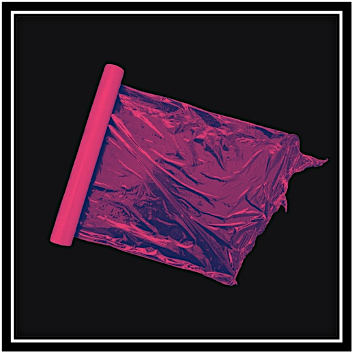
If you bought the wine recently (less than a month ago), immediately return the bottle, its contents and the cork to your wine shop or specialist store. If the wine is really affected by TCA or TBA, the seller will exchange it for you. They will then be responsible for alerting the distributor and the producer in order to correct a contamination problem that may exist in the cellar. But if it is a wine that you have been keeping for a longer time, and especially if it is a really special or precious wine, you can try to reduce the defect with the technique of cling film.
Be careful: a Halo wine, insofar as its concentration is extremely low, does not represent any danger to health. In other words, the cork taste is harmless, just annoying.
52.2.03: Decontamination technique
Take some cling film and put it into the bottle with a clean, sterile wooden stick. Carefully pour the wine already served into the bottle, then gently stir the plastic with the stick so that the whole wine is in contact with it. Finally, transfer the wine to a decanter. If the operation is successful, TCA-TBA contamination will be reduced; and even if the result is not absolutely perfect, the wine will become acceptable to the tasting.
Conclusion
At the end of this reflection, one word now imposes itself in the vocabulary of the informed taster: "Halo". Simple, direct, universal, and whose sound is reminiscent of a slightly worried "Hello!" thrown at the bottle: "Hey, is there anyone in there?" Because that's what it's all about: a "Halo" wine is a wine that calls out to you from the first nose, that signals that there is a problem, that something is wrong, that the expected aromas have been eclipsed behind a veil of mold, damp cardboard or a closed cellar. This term has the merit of going beyond the reductive notion of "cork taste", too often associated with cork alone, while haloanisole contamination can arise from many other unsuspected sources. To say "Halo" is to make a more accurate, more open diagnosis, and to invite us to look for the origin of the evil rather than to point to an overly convenient culprit. Better detection, better naming, better action: this is the virtuous chain that protects both the consumer and the producer's reputation. And while the cling film technique offers a lifeline for precious bottles, it may not be the only resource at our disposal...
Mr. B
*Memorandum:
My words and opinions in these newsletters are and would always be personal, and I intend to offend.
I always accept that others have the full right and duty to challenge me, to argue, and, if it is necessary, excommunicate me from their beliefs (often dull and hollow) because I would act the same way if it were the other way around.
Powered by Lightspeed
Display prices in:USD
