HOURS: TUESDAY - SATURDAY 12-9PM // CLOSED SUNDAYS & MONDAYS
Vol. 55 - Sense of Time
Click here for the pdf-formatted versionHarvard Square
Zero-Two-Wine-Three-Eight
The most opinionated wine Newsletter in America
The "Sense of Time"
When time becomes more important than place
Book of Bertil 55

Click here for the pdf-formatted version
Introduction:
Over the past thirty years, the world of wine has been built around an idea that has become almost universal: that of the "Sense of Place". This expression refers to the ability of a wine to tell the story of the place from which it comes. Geology, climate, relief, biodiversity, grape varieties, cultivation practices... All these elements shape its identity and allow the taster to recognize its origin. But is this definition still sufficient? As the climate evolves and the natural balances are transformed, another dimension appears with increasing evidence: that of time. If the Sense of Place allows us to understand where a wine was born, the "Sense of Time" helps us to understand when it was born. Because an artisan wine is not only the expression of a territory. It is also the meeting of several intertwined temporalities.
CHAPTER 1.0
Verse 54.01.01: Marking
It carries within it the deep time of geology, the time that has been built up over millions of years. It then tells the annual rhythm of the seasons, the winemaker's choices, the maturity of the vine, the ageing, the ageing in the bottle, and finally the unique moment when we taste it. The wine thus becomes a real living archive. Unlike a book or a monument, this archive cannot be consulted: it must be drunk. Each glass takes us on a journey through different time scales, from the birth of the terroir to the precise moment when the wine meets our senses. However, this apparent permanence is now confronted with a new reality.
Verse 54.01.02: The present time
Climate change is gradually changing the benchmarks that once seemed immutable. Aromatic signatures evolve, balances change, vintages merge more with each other and certain certainties acquired through decades of tasting become less obvious. It is precisely this reflection that came to me in the course of a recent experience.
Verse 54.01.02: A revelation as exciting as it is disturbing
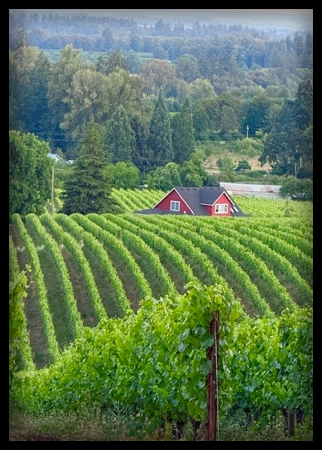
As many of you already know, I just spent four days in Oregon, in the heart of the beautiful Willamette Valley, for the Oregon Pinot Camp 2026 (OPC2026), whose theme this year was dedicated to "Sense of Place", explored from three angles: geology, biology and style variations. For four days, I had the exceptional privilege of tasting more than two hundred wines, mainly Pinot Noir and Chardonnay from the 2023 and 2024 vintages. The big dinners on Tuesday and Wednesday also allowed me to rediscover several older bottles. They came from the same territory but seemed to tell a different story. They always expressed their place of origin, but also another era. So, I came back from this immersion with a considerably enriched sensory memory, new knowledge of wine and wine, several new friendships, but above all with a deep questioning. The more I listened to biologists and winemakers, the more one question came up constantly. Is the Sense of Place still enough to explain a great wine?
Or should we now add another reading, just as fundamental: the "Sense of Time"?
Verse 55.01.03: When the sommelier's experience meets climate change
For a sommelier, the identification of a wine is first and foremost based on relatively stable criteria. The color provides information about the grape variety or the blend. The primary aromas make it possible to identify the varietal family. The structure of the wine, its body, provides indications of the nature of the soil. The acidity, the degree of alcohol and the maturity of the tannins provide information on the climate and the altitude of the vineyard. Finally, when it comes to a regulated appellation (Old World), the specifications also set out the authorized grape varieties, the production methods and the general style expected. All these elements make up what I would call timeless time, relatively constant characteristics that make it possible to identify the origin of a wine.
Verse 55.01.04: In addition, there is a second level of information: The temporal time.
This is everything that is specific to a given year. The weather of the vintage, the ripening conditions, and the decisions taken by the winemaker in the face of climatic hazards. Then the evolution of the wine during its ageing and ageing. In other words, the vintage is the expression of a year, while the terroir is the expression of a place. These two dimensions complement each other and form what we call the identity of a wine. To illustrate this approach, let's take a parallel with the history of art. Faced with the painting The Life of Pablo Picasso, several clues immediately allow us to locate its origin. The dominant blue and grey but with the very discreet appearance of pink. The slender figures with serious faces. The melancholy expression. All these elements naturally lead to the identification of the Blue Period, between 1901 and 1904, more precisely around 1903.
We proceed in exactly the same way when we taste a wine. We observe. We compare. We eliminate hypotheses. Then we gradually locate its origin, its style, its producer and finally its vintage.
CHAPTER 2.0
Verse 55.02.01: Climate Change: Goliath vs. Samson
Now let's compare it to a Pinot Noir from the Willamette Valley.
Its ruby color, slightly garnet, evokes a cool-climate grape variety. Its aromas of cherry, red fruits, pepper, undergrowth, notes of cola, and sometimes that famous chicken coop note immediately point to Oregon. Its freshness, natural acidity and balance confirm this first impression. Then the type of soil, the clones used, the vineyard or the AVA will then allow its origin to be further refined. Finally, the winemaking choices will often reveal the signature of the estate. So far, this method is working remarkably well. But it is here that climate change is gradually disrupting our reading. The climate of a year no longer produces only slight variations around a known pattern.
Verse 55.02.02: Our Benchmarks
The Oenologist's Picks in the Willamette Valley
On the scale of the Earth, the major geological and climatic transformations are measured in millions of years. Conversely, the history of modern Homo sapiens represents only a tiny fragment of time. For thousands of years, winemakers have worked with almost absolute certainty: that of a terroir whose fundamental characteristics remained stable from one generation to the next. The history of the vine in Oregon is also extremely recent. Vitis vinifera, the European vine from which the world's great grape varieties are made, has only been introduced to North America in recent centuries. The real establishment of the Willamette Valley only dates back to the early 1960s, barely sixty-five years ago. The first pioneers of Oregon therefore naturally sought to reproduce European models by selecting grape varieties according to the nature of the soil, choosing clones according to temperature, rainfall and sunshine duration, and then adapting yields in order to obtain the desired style of wine. Pinot Noir quickly established itself as the emblematic grape variety of this region whose cool climate was reminiscent of that of parts of Burgundy. Very quickly, another challenge emerged, which was to adapt this European vine to the biological realities of the American continent. For more than thirty years, almost all of the Willamette vineyards have been grafted onto rootstocks from American species such as Vitis riparia, Vitis rupestris or Vitis berlandieri, which are naturally resistant to phylloxera. But their role goes far beyond this protection.

Verse 55.02.03: The first part of Robot Cop: The rootstock
Each rootstock has its own personality. Some develop deep roots, others prefer superficial roots; some promote strong vegetative vigour, others naturally limit yields; some are more resistant to droughts, others to wetter soils. The choice of rootstock therefore directly influences the behavior of the vine and then guides the selection of the clone that will be grafted onto it. However, Pinot Noir alone now has more than a thousand clones listed, each offering different aromatic profiles, concentration levels and maturation rates. Thus, behind each bottle is a succession of human decisions: the choice of rootstock, clone, planting density, vine management and yield objectives. For more than half a century, all these decisions were based on a fundamental assumption: that of a relatively immutable sense of place, where the terroir constituted a stable reference around which the oenologist could build the identity of his wines.
It is precisely this balance of geology, climate, plant material and craftsmanship that has shaped the recognizable personality of Oregon Pinot Noir over the decades. Today, this certainty is gradually being called into question by the acceleration of climate change, forcing winemakers to rethink choices that were previously thought to be definitively taken for granted.
Verse 55.02.04: The second piece of Robot Cop: New Oak or Neutral barrel
Traditionally, Oregon Pinot Noirs followed the rhythms of Burgundy winemaking, neutral barrels for most of the year's winemaking, thoughtful blends of different clones and climates, long maturation, all to reflect the finesse of the fruit. Its typicity was therefore based on its soil of origin, and its power and concentration on its geographical origin. These two factors are the fundamentals of the Willamette Valley AVAs (11 nested Sub-AVAs). The style and quality of the winemaker therefore differentiates the origin of the vineyard and its winemaker. But alas, to my great surprise last week, all these landmarks became non-existent in the 2023-2024 and 2025 vintages that I had the chance to taste.
Verse 55.02.05: The third piece of Robot Cop:
The choice between destemming and whole-cluster fermentation
This choice is one of the main markers of the style of Pinot Noir producers. Thanks to the cool climate of the region, the stems frequently reach sufficient physiological maturity to be integrated into the winemaking process without bringing excessive vegetal character. A fully destemmed Pinot Noir favors a precise and crystalline expression of the fruit, revealing aromas of red cherry, morello cherry, raspberry, cranberry and pomegranate, supported by fine tannins, a velvety texture and a generous palate where the terroir is expressed mainly through the fruit. Conversely, the use of whole bunches, generally between 20 and 100% depending on the estate, the vineyard and the vintage, brings a more vertical architecture, firmer but often very refined tannins, a feeling of increased freshness and greater persistence. The aromatic register then evolves towards notes of violets, rose petals, black tea, sweet spices, white pepper, sandalwood, pine needles and undergrowth, to which is added an airier texture and energy that accentuate the minerality of the wine. In the best vintages, when the stems are perfectly lignified, this practice reinforces the complexity and the ageing potential without masking the identity of the vineyard. It is one of the preferred tools of the Willamette winemakers to translate not only the sense of place, but also their own vision of Pinot Noir, seeking a subtle balance between the purity of the fruit, the tension, the depth and the most faithful expression of each terroir.

CHAPTER 3.0
Verse 55.03.01: 2023-2024-2025
A very linear and merged tasting
One of the most important consequences of the succession of hot vintages of 2023, 2024 and 2025 in the valley is that they call into question several winemaking decisions made thirty to fifty years ago, at a time when the region was considered a marginal area for the ripening of Pinot Noir. Clones and rootstocks were then selected to promote optimal maturity in a cool climate: relatively early maturing clones (Dijon 113, 114, 115, 667, 777), vigorous rootstocks favoring rapid production and good vegetative development, as well as planting densities designed to maximize the sunshine of the bunches. Today, these same choices sometimes have the opposite effect. Higher temperatures accelerate the accumulation of sugars, bring forward harvest dates and lead to higher alcohol levels, while phenolic and aromatic maturity does not always progress at the same rate. Pinot Noir gains in color, concentration and tannic richness, but can lose some of what historically made its identity: the finesse, tension, transparency of the fruit, floral delicacy and vibrant freshness that distinguished Willamette from many other Pinot Noir-producing regions.
Verse 55.03.02: The Sense of Place
Today
For decades, the Willamette Valley was one of the few regions capable of producing a Pinot Noir whose identity was based above all on the expression of the terroir. Each AVA had its own signature. The mineral tension of the Eola-Amity Hills, the generosity of the Dundee Hills, the floral finesse of Ribbon Ridge or the depth of the Yamhill-Carlton. The Sense of Place was thus the main reference point for tasting. Today, this benchmark is evolving. It is now influenced by a Sense of Time whose weight becomes more decisive each year. The climate no longer only shapes vintages: it gradually redefines the very identity of the terroirs. This is undoubtedly one of the greatest challenges of contemporary tasting, it is to learn not only to recognize a place, but also to understand how time is transforming it.
During the Oregon Pinot Camp, an impression came up many times during my tastings of the 2023, 2024 and 2025 vintages. While some wines retained a strong personality, a significant number of them seemed to share the same stylistic trajectory. The differences between AVAs, once immediately noticeable, sometimes faded behind a more uniform expression of blacker fruit, increased concentration, higher alcohol levels, denser substance, and a fuller mouthfeel. This power, sometimes close to that traditionally associated with certain Pinot Noir from warmer regions of California such as Napa, tended to homogenize the profiles. Where each terroir once told its own story, the climate now seemed to write part of the common narrative. It is not the disappearance of the Sense of Place, but its increasingly close dialogue with the Sense of Time.
Verse 55.03.03: The Sense of Time:
Tomorrow
This new reality is already forcing winemakers to rethink decisions that, for half a century, seemed immutable. The most vigorous rootstocks, once selected to promote ripening in a cool climate, are gradually giving way to plant material capable of better resisting water stress and naturally slowing down the vegetative cycle. Producers are also interested in later clones as well as massal selections, which are likely to offer a more gradual maturation and a more complex aromatic expression. The vineyard itself is in full geographical evolution. While early plantings were typically between 200 and 400 feet above sea level, many new vineyards are now established at more than 1,000 feet, seeking cooler temperatures and slower ripening. The orientations are also changing with hillsides facing north or north-west, long considered too cold, now becoming sought after to limit direct sunlight. The vine management also changed with more leaf surface area being kept to protect the bunches, leaf removal was practiced with more restraint, yields were reassessed, the most ventilated plots, particularly under the influence of the Van Duzer Corridor, were particularly sought after, while drip irrigation, once exceptional, is gradually becoming a tool for adaptation in certain sectors. The question is therefore no longer just which clone, rootstock or terroir produces the best Pinot Noir. It is now a question of knowing what choices will make it possible, in twenty or thirty years, to preserve what has made the Willamette Valley's world reputation, i.e. wines where the elegance, the transparency of the fruit, the freshness and the identity of each terroir remain stronger than the standardization imposed by a changing climate. Because the real challenge is not simply to continue to produce great Pinot Noir; it is to preserve their ability to tell the story of a place, rather than becoming witnesses to a globalization of taste.
Conclusion:
The climate forces winemakers to rethink the "Sense of Place"
Perhaps the biggest upheaval caused by climate change is not the increase in temperatures or the progress of the harvest. It lies in a much deeper transformation: that of our relationship with the "terroir." For centuries, the Sense of Place has been built on the idea of permanence. The geology, relief, climate and landscapes formed a relatively stable framework in which each generation of winegrowers refined its know-how without calling into question the very foundations of its identity. The "Terroir" according to the definition of the old world appeared as a truth to be revealed, not as a reality to be endured and reconstructed. Today, this certainty is wavering. The long time of geology meets the short time of human activity. In just a few decades, the climate is changing the balances that had taken centuries to establish. The winegrowers then become much more than interpreters of the Sense of Place, they become its guardians. His choices are no longer solely about producing the best possible wine, but about preserving the expression of a place whose natural landmarks are gradually shifting. The sense of place thus ceases to be a fixed notion and becomes a responsibility. It is no longer just a question of faithfully expressing a terroir, but of preventing it from losing its identity under the effect of a climate that tends to standardize wine-growing landscapes and sensory profiles. This responsibility goes far beyond technology. It touches on a fundamental philosophical question.
The beginning of this transformation therefore also rests on each one of us. With each purchase, we choose the wine model we want to support. By favoring wines from ecological and eco-responsible practices, we are not only encouraging more sustainable agriculture; we also participate in preserving the identity of the Sense of Place for future generations. Because protecting a great wine is first and foremost about helping its craftsperson to preserve the place that gives it life. And you, what do you choose to do?
54 Church Street, Cambridge MA 02138 · www.bondewines.com
Powered by Lightspeed
Display prices in:USD
