HOURS: TUESDAY - SATURDAY 12-9PM // CLOSED SUNDAYS & MONDAYS
CLOSED THANKSGIVING // BLACK FRIDAY 12-9
Randall Graham
« The Terroirist »
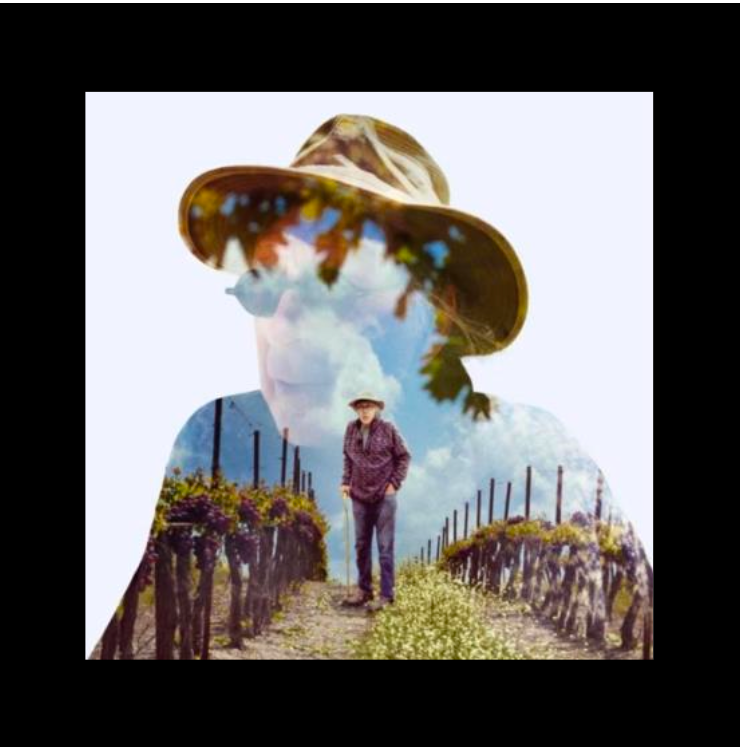
Click here for the pdf-formatted version
Introduction
Some believe that destiny places men and women on our path to show us the direction to follow, or to push us toward sharper reflection on our existence. That was the case for me, who had the immense fortune to meet Randall Graham, to listen to him, and to follow the evolution of his thinking. Since the late 1980s, he has become for me a mentor, a druid, a friend, always one step ahead of what I was trying to understand from his reflections of the moment and his vision of wine. First came Bonny Doon Vineyard and my revelation, in 1988, in front of a Flying Cigar produced in very small quantities, hard to find on the ordinary market. Then the incomprehension in front of Ca' del Solo and its large-scale commercial excesses. Then came the fascinating adventure of biodynamics; barely had I begun to grasp his approach to this holistic practice when he made a reversal, returning to an almost monastic, almost Carthusian work. His world, constantly crossed by new discoveries, new approaches, and new techniques, has never ceased to destabilize me and challenge my winemaking and philosophical convictions. For this, I am grateful to him, and I appreciate the privilege of counting among those humble individuals with whom he shares his reflections, in this abyss of the absolute. So, taking advantage of the release of "The Terroirist," I take today to share with you 40 years of reflections.
CHAPTER 1.0
Verse 61.1.01: Randall Graham:
in search of the last Golden Fleece.
From the Burgundian dream to the utopia of Popelouchum, the odyssey of a winemaker who refuses to believe that everything has already been discovered. In Greek mythology, Jason boards the Argo to find the Golden Fleece, a treasure whose value lies as much in its meaning as in its possession. He crosses unknown seas, faces senseless trials, and pursues an ideal whose true achievement he does not yet know. More than two millennia later, in California, Randall Graham seems to have embarked on a comparable odyssey. His Golden Fleece is neither a precious object nor a legendary grand cru, but a wine that does not yet exist.
61.1.02: Utopia: A quest towards the Impossible.In Utopia, published in 1516, Thomas More imagines an ideal world whose name literally means "non-place." Utopia is precisely that place found on no map, but whose imaginary existence pushes us to question the real world. For Randall Graham, this utopia now has a place: Popelouchum Vineyard. But to understand this wine-growing paradise, one must return to another promised land, that of Burgundy.
61.1.03: Pinot Noir, first love and first disappointment.In the 1970s, young Randall Graham worked at The Wine Merchant in Beverly Hills. There, he discovered great French wines, particularly Burgundies, whose complexity and expression of the terroir transformed his understanding of wine. A 1949 Musigny from Domaine Comte Georges de Vogüé deeply shaped his imagination, so he became convinced he had to dedicate his life to producing the great American Pinot Noir. Before his studies at UC Davis, Randall Graham studied at the University of California, Santa Cruz (UCSC) around 1974, where he was mainly interested in three disciplines: philosophy, including existential questions, literature, and preparatory studies for medicine. But this revelation of the existence of a possible wine (Pinot Noir) transcendental led him to pursue his studies in oenology, where he graduated from the University of California, Davis in 1979. That same year, thanks to his family's support, he acquired land in the Santa Cruz Mountains and founded Bonny Doon Vineyard in 1983. But very quickly, he realized that nature did not share his Burgundian ambitions, as Pinot Noir did not meet his expectations. The climate of Santa Cruz was warmer than expected, and the results were very disappointing compared to his ambitions for quality. Yet, this failure became his first true lesson in the meaning of place.
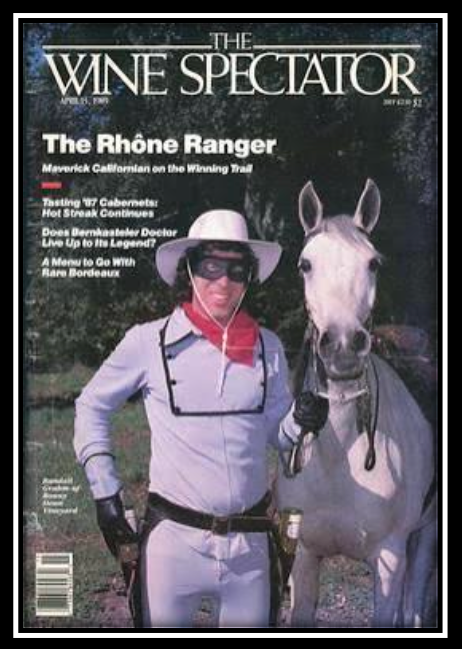
61.1.04: You can't impose a dream on the land.Rather than persisting in imitation, Graham turned to Rhône grape varieties. Syrah, Grenache, Mourvèdre, and other Mediterranean varieties opened new perspectives for him, and in 1984 Le Cigare Volant was born, a blend inspired by Châteauneuf-du-Pape, accompanied by a label featuring a flying saucer, and this wine became the emblem of a new generation of Californian producers. Then, in 1989, Wine Spectator immortalized Graham under the nickname "Rhône Ranger." It was then that the former disciple of Burgundy became one of the revolutionaries of American wine.
CHAPTER 2.0
Verse 61.2.01: Randall Grahm, a visionaryThe Rhône Ranger that revolutionized Californian wine.
Alongside Bob Lindquist, Steve Edmunds, and Gary Eberle, he contributed to the emergence of the Rhône Rangers, a movement that challenged the dominance of international grape varieties. Immortalized as a masked cowboy on the cover of Wine Spectator in 1989, Graham became the face of this revolution, and his influence far exceeded Rhône grape varieties, as he demonstrated that California could break free from European models to develop its own winemaking identity.
61.2.02: Randall GrahmBiodynamics as a quest for the truth of the terroir.
In the early 2000s, Randall Graham undertook a profound reassessment of his winemaking philosophy. After revolutionizing the Californian landscape with Rhône grape varieties, he questioned a fundamental question: "How to produce a wine that truly expresses its terroir rather than the technical choices of the winemaker?" His research led him to the influence of European producers' practices and Rudolf Steiner's principles, and as early as 2003, Graham undertook a conversion to biodynamics, accompanied by French specialist Philippe Coderey, a former collaborator of Michel Chapoutier, then in 2007, his Ca' del Solo vineyard obtained Demeter certification. Although he was not the first to adopt this approach in California, preceded notably by Benziger and Bonterra, Graham became one of its most influential ambassadors. But for him, unlike other pioneers, biodynamics went beyond the simple environmental approach, as it favored soil vitality, biodiversity, and the natural balance of the vine, hoping to reveal a more authentic expression of the place. These reflections were the beginnings of what would become regenerative viticulture.
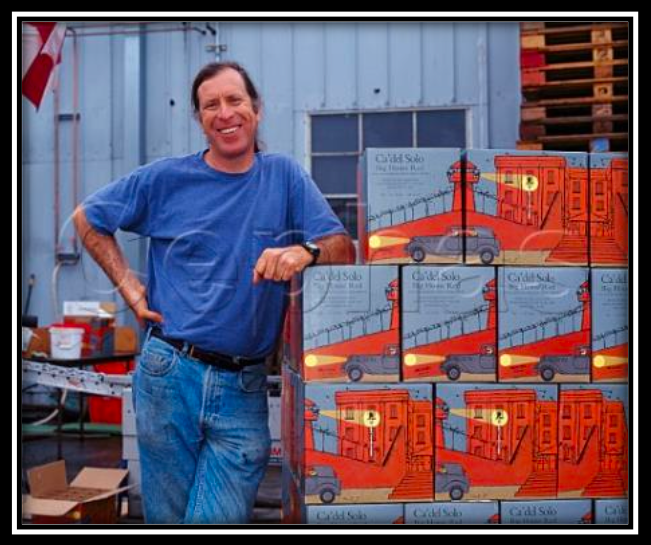
Bonny Doon grew, brands multiplied, volumes increased, and Randall Graham became an essential figure in the wine industry. But as his business prospered, a contradiction emerged: how to defend the uniqueness of the place while producing hundreds of thousands of cases intended for a national market? So, in 2006, Graham began to part with his most commercial brands, and he gradually chose to sacrifice volume in search of authenticity. This decision marked a philosophical turning point for Randall, as it was no longer just about choosing the right grape varieties, practicing biodynamics, or reducing oenological interventions. Graham wants to understand whether a wine can truly express a place rather than the intentions of its creator. This is a fundamental question for him, especially in a California where the notion of place, the "terroir," often remains overshadowed by the prestige of the grape variety and the winemaker's signature.
CHAPTER 3.0
Verse 61.3.01: Popelouchum, the impossible paradiseThen Randall Graham acquired the Popelouchum* estate in 2011, near San Juan Bautista, in San Benito County, California. A paradise property spanning about 160 hectares, close to the San Andreas fault.
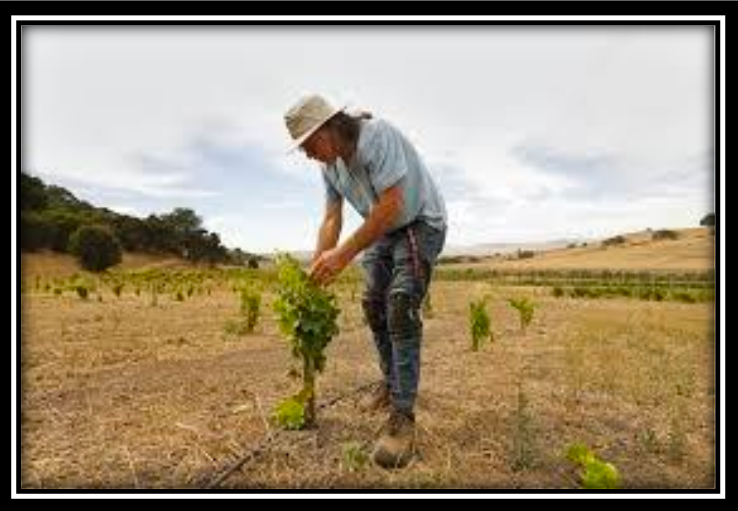
On this property, of which about twelve hectares are planted, Graham pursues an idea that might seem absurd: to create new grape varieties from grape seeds. Usually, the vine is propagated by cuttings and grafting, which helps preserve the genetic identity of a grape variety; but as Randall knows, each seed from sexual reproduction has a distinct genetic heritage. So why not harness this diversity to discover a variety naturally adapted to a specific place? Because this is exactly how the "terroirs" of the old continent were created. So Randall Graham initially imagined evaluating thousands of new vines, with the ambition not to create an additional international grape variety, but to find a variety whose characteristics would favor the expression of Popelouchum. But the project encountered immense difficulties, and its experiment has now focused on about 150 descendants of Sérine, a former selection associated with northern Syrah, among whom are white and red grape varieties.
*Popelouchum means "paradise" in the Mutsun language, that of the indigenous peoples of this California region.
Time, the last adversary
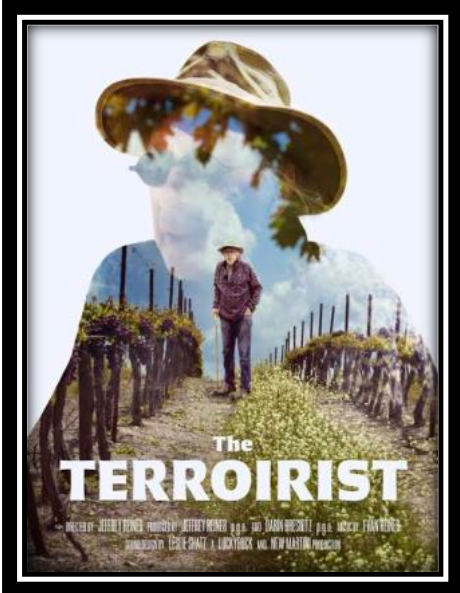
A new variety guarantees neither a great wine nor a better expression of the terroir, but for Randall, it is precisely this uncertainty that makes the venture fascinating, as he seeks what no one can guarantee he will find. The documentary “The Terroirist”, directed by Jeffrey Reiner and premiered in early November 2026, adds a moving dimension to this adventure. Randall Grahm, now 73 years old, reveals that he suffers from Parkinson's disease and severe joint pain. The film shows an aging man, sometimes walking with a cane between his rows of vines, aware that the biological calendar of a vineyard does not necessarily coincide with that of human existence, because varietal creation requires years, sometimes generations. You must observe, select, vinify, start over, and above all accept that some answers may come too late. Randall Graham knows this, and yet insatiable, he continues.
*The film has been available for streaming (in English) since November 13, 2026, on platforms such as Apple TV, Amazon Prime Video, Google Play, and YouTube.
61.3.03: A hope, a possible successionThe true Golden Fleece
His daughter Amélie has recently shown a budding interest in wine, hinting at the possibility that this work might outlive her. But Popelouchum is not yet a certain legacy, as it is a fragile promise, suspended between science, hope, and time. Jason was searching for a treasure. Thomas More imagined an impossible place. Randall Graham, for his part, has been pursuing a winemaking truth for nearly fifty years that seems to shift as he approaches. Initially convinced that great American wine must resemble Burgundy, he discovered that California could speak another language with Rhône grape varieties. Today, he envisions inventing its own vocabulary. Perhaps Randall Graham’s most important contribution to the history of American wine, reminding us that the meaning of place, the "terroir," is not a recipe, much less a commercial argument, but a patient relationship between a land, a plant, and the one who agrees to listen. In The Terroirist, Graham describes his work in the vineyard as a spiritual path, a way to leave the world of ideas
Conclusion
And perhaps this is the most beautiful irony of this odyssey. After leaving the Bourgogne dream for the Rhône, exploring biodynamics, giving up volume and dreaming of grape varieties that do not yet exist, and that the most beautiful wines of Popelouchum today is a Pinot Noir unrooted, the same grape variety that had disappointed him so much at the beginning, in the Santa Cruz Mountains. This grape variety of his first loves and his first disappointment thus returns to him, not imposed on the land, but welcomed by it. Planted on his own roots, without graft or intermediary, he expresses what the young winemaker sought without knowing it: “The voice of a place”. As if, after fifty years of detours, the Golden Fleece had always been there, lurking in the Burgundian dream of departure, waiting for man to finally learn to listen to it. For my part, after nearly forty years following its self-questioning, this loop only surprises me halfway. My friend and mentor taught me that truth in wine is never a destination, but a path that brings us, transformed, back to our starting point, without stopping to question ourselves.
*Memorandum: My words and opinions in these newsletters are and would always be personal, and I intend to offend.I always accept that others have the full right and duty to challenge me, to argue, and, if it is necessary, excommunicate me from their beliefs (often dull and hollow) because I would act the same way if it were the other way around.
HOURS: TUESDAY - SATURDAY 12-9PM // CLOSED SUNDAYS & MONDAYS
CLOSED THANKSGIVING // BLACK FRIDAY 12-9
