
HOURS: TUESDAY - SATURDAY 12-9PM // CLOSED SUNDAYS & MONDAYS
Whistleblower: An Open Letter to Mr. Asimov
Whistleblower
An Open Letter to Mr. Asimov
Regarding two New York Times Articles:
Sir,
I am not a public figure, nor someone widely known. Yet I belong to a generation of true, working sommeliers those who, more than 30 years ago, built their legitimacy not through formal diploma, but through mentorship, hands-on service, daily study of wines and terroirs, and a deep understanding of cuisine, its techniques, its balance, cellar management, pedagogy, and the diplomacy required on the floor. This path, grounded in experience and discipline, earned us the respect of our peers and of great establishments, allowing us to compete in and win international sommelier competitions. But above all, it taught us how to recognize and defend the work of artisan winemakers, whose commitment and dedication give life to the wines we serve and pass on.
Yes, I come from that old guard, not out of nostalgia, but because I see that foundation now being weakened, sometimes replaced by a faster, more superficial approach, where titles can precede depth. It is in this context that I feel compelled to respond. For me, staying informed is not optional, it is essential. Like the sommeliers of earlier generations, I read international publications daily, covering wine, gastronomy, and their cultural and anthropological dimensions. Your work in The New York Times, along with your public presence on social media, is naturally part of that landscape.
You hold a position of influence. Your voice helps shape how wine is perceived by a broad audience in the United States and beyond across generations, from younger consumers to more experienced ones, many of whom are educated and engaged. That responsibility is considerable. Allow me to remind you that your words do not merely express opinion; they guide, they influence, and at times, they shape economic realities. In that sense, their impact is not unlike that of figures such as Robert Parker or Jon Bonné.
Disagreement is not an issue, it is even necessary in a field as subjective as taste. There have been times when I did not share your views, without that ever diminishing the respect I have for your work.
But here, Sir, the situation is different. This is no longer a matter of interpretation, but of positioning, one whose implications extend beyond editorial boundaries. Some of the information conveyed can have real consequences, particularly for winemakers who, far from media platforms, commit their lives, their livelihoods, and their integrity to their craft. That is why I cannot remain silent. The concern I feel is proportional to the potential impact; a few lines can influence the choices of thousands of consumers and, in doing so, disrupt already fragile economic balances.
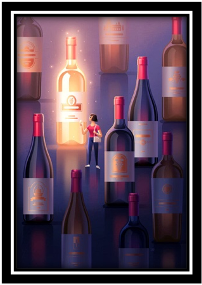
Jon Reinfurt
Today, on behalf of these winemakers and these working professional sommeliers, I speak as a whistleblower. Let me be clear on one essential point: I want to believe that your original intent was not malicious. Precisely for that reason, it is all the more important to measure the real-world impact of what is published.
Your first article on A.I. and sommeliers was deeply unsettling. Your role is not simply to report facts, as a field journalist might. You are, first and foremost, a wine critic, a recognized voice in the industry, one that is expected, heard, and respected. In a world where anyone can now claim to be a wine or restaurant critic, where opinion has become diluted and fragmented, and where objectivity often gives way to noise, your voice carries particular weight. It should help clarify, nuance, and guide with rigor. That is precisely why it is disappointing to see your words lending implicit legitimacy to a vision that risks fundamentally distorting our profession. Yes, artificial intelligence can be a powerful tool, useful, even efficient. But it will never replace a sommelier, a wine steward, or a trained server capable of listening to a guest, sensing a mood, understanding context, reading between the lines, and ultimately delivering what the guest is truly seeking. A true human experience.
At the same time, you yourself acknowledge that restaurant wine prices have, in many cases, become excessive. If that is the case, then at the very least, that price should enhance the guest experience, not justify charging full price while suggesting that artificial intelligence could effectively replace front-of-house professionals in guiding wine choices. That is neither hospitality nor professionalism. On the contrary, consumers should be encouraged to recognize the value of the professionals present in our restaurants. When a guest leaves a tip, it is not for an interface, an algorithm, or a robot, it is for the quality of the welcome, the service, and the human attention provided. Will we soon be expected to tip artificial intelligence, or the robot delivering a Tournedos Rossini to the table?
It is also essential to distinguish between the realities of a small neighborhood restaurant and those of a Michelin-starred establishment. Guest expectations are not the same, especially when the price of a bottle is marked up fourfold. The higher the price, the greater the legitimate expectation for expertise, guidance, and human presence.

Nicolas Ortega
Turning to your second article, your approach seems equally problematic. Once again, you adopt the posture of a mere conduit of information, where a deeper, more responsible and more insightful analysis would be expected. Why resort to such generalization, when readers are likely to retain a simplified even misleading takeaway. That an “acceptable” bottle of wine now costs around $20, up from $15, due to tariffs, fuel costs, and inflation? At best, this assertion is incomplete. Your readers including younger consumers, particularly Millennials and Gen Z, are willing to pay more, provided there is a clear and meaningful alignment between price, quality, and experience. The issue is not simply paying more but understanding what one is paying for. I am not referring here to the “indifferent” consumers you describe, but rather to those seeking the best possible balance between quality, price, and value, a goal you yourself claim to uphold.
“Drill, baby, Drill”
Allow me to point out that a European wine retailing at $20 in the U.S. is often sourced at under €4 at the winery. At that price point, we are, in the vast majority of cases, dealing with standardized wines so-called “process wines” designed to meet volume and market constraints rather than express terroir or a winemaker’s vision. These wines are present, certainly, but rarely carry identity or emotion, and are far removed from any notion of “healthy drinking,” given the widespread use of additives, industrial inputs, and chemical interventions, a reality increasingly out of step with post-pandemic consumer expectations.
If, on the other hand, one chooses to drink healthier and more consciously for example, wines labeled eco-responsible (organic, biodynamic, sustainable, natural, regenerative) one should expect average retail prices between $28 and $39 at independent wine shops on the U.S. East Coast. Wines that genuinely contribute to the consumer experience, those with depth, meaning, identity, and integrity, were already priced at $20 and above well before the pandemic. By contrast, domestic wine production in the United States is not inherently more expensive than comparable wines produced in Europe. And importantly,
unlike imported wines, more than 45% of the retail price often goes directly back to producers rather than being absorbed by layers of intermediaries. This is a reality that deserves to be acknowledged and properly contextualized. To suggest, therefore, that a “decent” bottle of wine now sits at $20 establishes a distorted and, in practice, misleading, perception of the market.
My humble conclusion:
This is precisely why your role matters. You have the ability and, to some extent, the responsibility to advocate for a more accurate, more demanding, and more truthful understanding of our field. Wine is not a commodity; it is the expression of craftsmanship, culture, and human connection and it deserves to be valued at a fair price that reflects the work behind it. Its service, when properly executed, is itself a living art. With that in mind, rather than directing your voice toward the promotion of convenience stores, liquor stores, large-scale retail chains, or discount-driven online platforms, and price-driven distributors, I would urge you to use your influence to support the true pillars of the wine world. The curated selections offered by independent wine merchants, neighborhood wine shops, the remarkable value of wines produced within our domestic market, and the often underrecognized, yet essential, work of sommeliers in our restaurants.
Ultimately, the question is simple: what kind of wine culture do we choose to uphold? One shaped by convenience, volume, and simplified narratives, or one grounded in integrity, human connection, and respect for those who grow, craft, and serve wine? As your words continue to shape perceptions and influence decisions, will you choose to reflect the complexity and truth of this world, or contribute to its dilution? And ultimately, what responsibility do we collectively bear in preserving the meaning, value, and dignity of wine and of its artisans for generations to come?
Respectfully yours
Bertil Jean-Chronberg
Powered by Lightspeed
Display prices in:USD
