HOURS: TUESDAY - SATURDAY 12-9PM // CLOSED SUNDAYS & MONDAYS
Vol. 51 - "Vermont Wine"
Click here to read the pdf-formatted version
Vermont Wine
A forgotten region
Book of Bertil 51
Introduction
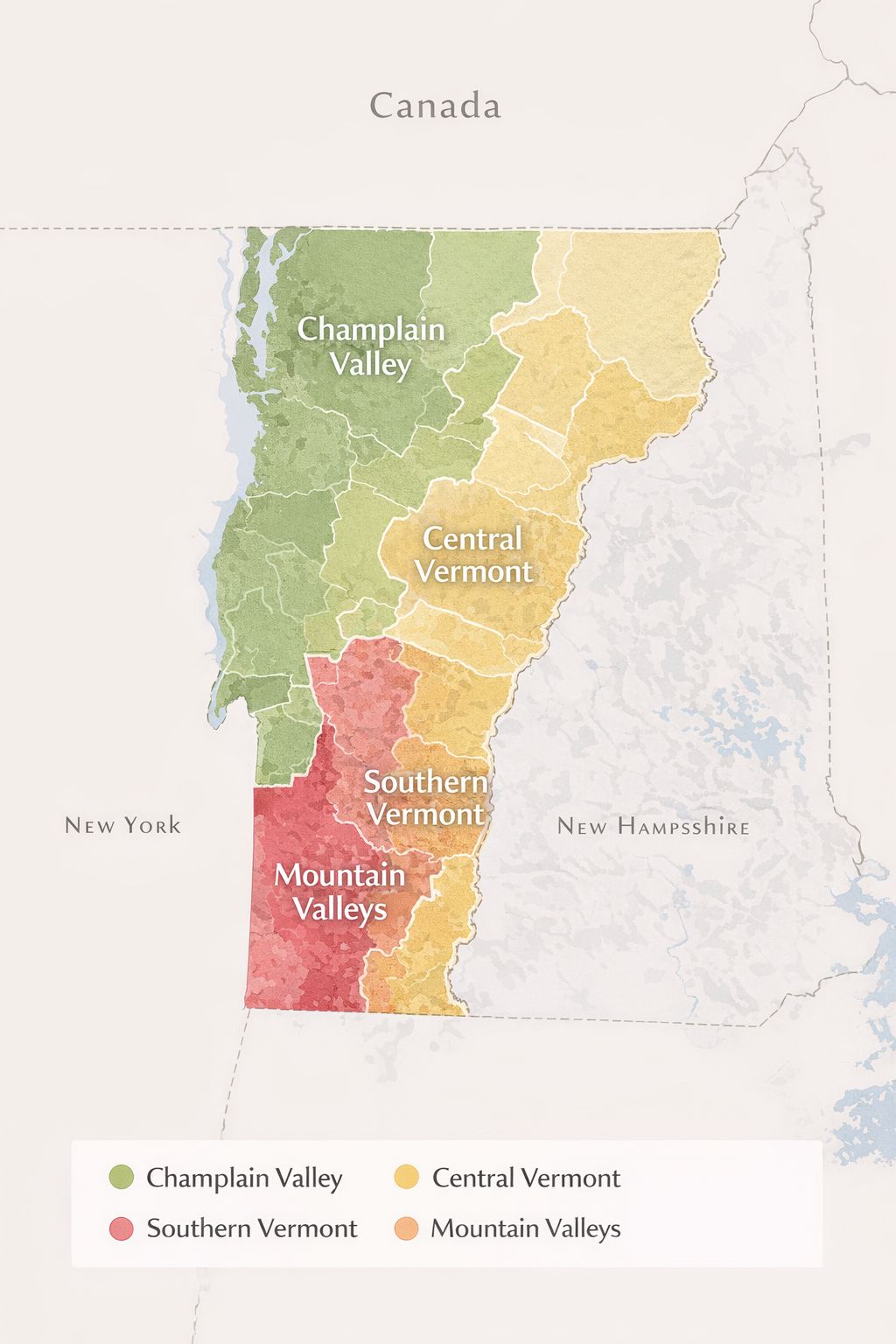
Although Vermont was an independent republic in the 18th century, known as the Republic of Vermont (1777–1791), with its own constitution and government, it was neither a classic British colony nor an American state. Yet this state has become one of the foundations of modern America. Known for its maple syrup production and farm products, this "Green" state is still largely unknown for its wine production. However, the effect of climate change and the significant progress made in recent years in the development of new hybrids adapted to its climate make it a more than promising territory today. With its four major regions, its specific soils and its microclimates, I invite you to follow me to discover the history and vineyards of this region of the northeastern United States. "Ayuh"!
CHAPTER 1.0
Verse 51.1.01: The Colonial Period (17th–18th centuries)
In colonial times, Vermont was far from being a land of wine, but rather a misunderstood promise. The settlers observed abundant wild vines (Vitis labrusca), but their vinification produced rustic liquids, often foxed, far from European quality standards. The ambition to reproduce the great wines of the Old Continent came up against a brutal climatic reality, in a still virgin territory, marked by early frosts, short seasons leading to incomplete ripeness, as well as fungal diseases and phylloxera. The wine-growing narrative of this period is therefore one of an agronomic misunderstanding: a fascination for the vine without any real control of the terroir, in a landscape dominated by mountains, maples and agriculture focused on livestock farming.
51.1.02: The Nineteenth Century: The First Structured Essays
This century marks a transition to a more scientific, if still hesitant, approach. After the phylloxera crisis in Europe (1863–1890), many hybrid grape varieties were developed in France and then introduced in North America. These varieties show a willingness to adapt rather than imitate. However, the wines remain anecdotal, often perceived as simple agricultural curiosities rather than quality products. Faced with the rise of more favorable regions, Vermont struggled to define a real identity. Wine is produced there, of course, but without any clear stylistic ambition. The nineteenth century was thus marked by a test viticulture, which was more experimental than convincing.
51.1.03: The Crisis of the Early Twentieth Century (Prohibition)
Decline and Interruption
The Prohibition of 1853 to 1903, followed by the National Prohibition (18th Amendment) from 1920 to 1933, completed an already fragile activity. In Vermont, the vine disappeared almost without resistance, replaced by dairy farming that was much better adapted to the climate and the market. This long eclipse erases all historical continuity. Unlike other American regions, there is no wine memory to preserve here. Vermont entered the twentieth century as a virgin territory in terms of oenology, without tradition or claimed heritage.
51.1.04: The Renaissance of Local Viticulture (1970s–1990s)
Vermont's wine renaissance is as much a leap of faith as it is an innovation. Carried out by pioneers who are often marginal, it relies on hybrid grape varieties capable of surviving where Vitis vinifera fails. The first modern wines were uneven, sometimes technically approximate, but they laid the foundations for a new language. It is no longer a question of competing with the major American regions, but of creating a credible local expression. This period forged Vermont's DNA, with resilience, pragmatism and continuous experimentation. At the beginning of the 1970s, viticulture was still in its modern infancy. There are no recognized figures or established structures. We are talking more about isolated precursors than real estates. These actors are less winegrowers in the classic sense than agronomic experimenters, exploring the limits of the climate. Their production remains marginal, often domestic, and rarely documented.
Outside influences, from New York to Minnesota
From the 1970s, hybrid research conducted in New York State (notably at Cornell) and at the University of Minnesota strongly influenced Vermont. Researchers and agronomists introduced more resistant varieties, making the Champlain Valley the main testing ground for these new grape varieties.
51.1.03: Expansion and Structuring (2000s)
The end of the 1990s and the beginning of the 2000s saw the emergence of a real wine scene, still modest but increasingly coherent. Producers are refining their practices, mastering hybrids better and gradually assuming their uniqueness. The obtaining of the AVA Vermont in 2022 consecrates this evolution, although this recognition is still symbolic on a national scale. The wines gain in precision. The AVA is divided into wine-growing sub-zones, as the climatic profiles vary, but in general we find wines marked by a clear acidity, frank and sometimes surprising aromas. However, the question of recognition persists, because Vermont produces interesting wines, but still in search of national legitimacy.
CHAPTER 2.0
Verse 51.2.01: The Pioneers of Modern Times
David Boyden — Shelburne Vineyard (1998)
Probably the most structuring figure in Vermont winemaking. A former lawyer turned winemaker, trained in California, he is co-founder of Shelburne Vineyard, now one of the most recognized estates in the state. Boyden helped professionalize local viticulture by demonstrating that a viable business model was possible.
Bob & Julie Pratt — Snow Farm Vineyard
Among the first to plant seriously in the 1990s on the islands of Lake Champlain, their work highlights the importance of the microclimate, in particular thanks to the moderating effect of the lake on the vine.

Ken Albert — Lincoln Peak Vineyard (2006)
Another major player in modern commercial viticulture, he founded Lincoln Peak Vineyard with an emphasis on accessible wines, often made from hybrid grape varieties vinified as a single variety. Since 2025, two young winegrowers, Nichole Bambacigno and Kevin Bednar (pictured above), have taken over the estate and produce high quality wines.
Deirdre Heekin & Caleb Barber — La Garagista
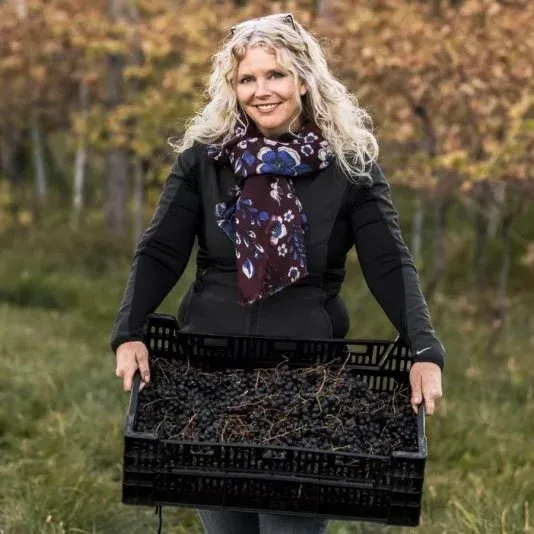
Some of the most influential and media-friendly figures in Vermont winemaking. Founder of La Garagista Farm Winery in 2010, Deirdre Heekin is developing a biodynamic approach, in natural fermentation, with a very artisanal production. It embodies a radical vision of "natural" wine, sometimes polarizing, but arguably the most singular expression of contemporary Vermont. She is also recognized as the major initiator of the demand that led to the creation of the AVA Vermont.
51.2.01: Today: Current Situation
Today, Vermont embodies niche, almost militant viticulture. The wines, often lively, marked by a sharp acidity and floral or exotic aromas, appeal to a curious rather than a traditional audience. The reds, made from grape varieties such as Marquette or Frontenac, offer structure and freshness, but sometimes struggle to reach real depth. Global warming opens up new perspectives without erasing the risks. More than an established wine region, Vermont appears as a living laboratory, where wine can be redefined in extreme climates.
CHAPTER 3.0
Verse 51.3.01: AVA Vermont
Created and validated in 2022 by the TTB, the designation covers the entire state. Unlike regions such as California or New York State, there is no official subdivision (Sub-AVA). Nevertheless, four major geographical areas are recognized informally. Vermont thus appears less as a mosaic of terroirs than as a coherent experimental block, still in the definition phase.
Fact: In 2026, the region remains modest in volume but growing, with about 23 producers/wineries.
Conclusion
Vermont is not yet on the great American wine lists, and this is precisely what makes it unique. For a long time, a virgin territory in terms of winemaking, it inherited neither a burdensome tradition nor a fixed model. This absence is now becoming a strength, that of an open space, where everything remains to be written. Driven by climate change, advances in hybrid grape varieties and a new generation of committed winemakers, Vermont is gradually positioning itself as a credible testing ground. Here, the wine does not seek to reproduce, but to adapt, to interpret, to exist in an extreme context. Still fragile, sometimes uneven, but undeniably alive, this vineyard in the making could well embody one of the contemporary responses to the climatic challenges of viticulture that will be imposed on us tomorrow. So, more than an emerging region, Vermont is perhaps a glimpse of the future, that of wine born of constraint, shaped by innovation, and freed from traditional models. It remains to be seen whether this future will be able to be structured... or if it will remain voluntarily undisciplined.
Vermont Wine Regions
Terroirs and Viticultural Expressions
❖ Lake Champlain Valley (heart of the vineyard)
Climate: Densest area, benefiting from the lake’s thermal effect, where the majority of commercial estates are concentrated
Dominant soils: Lacustrine clays, silts, point limestones, alluvial sands and gravels
Viticultural reading: The most "wine-growing" soils, good water retention but sometimes insufficient drainage
Impact on wines: Balanced wines, integrated acidity, clear aromatic expression
Vineyards:
- Shelburne Vineyard
- Lincoln Peak Vineyard
- Snow Farm Vineyard
- Boyden Valley Winery
- Charlotte Village Winery
- Isle La Motte Vineyard
- Due North Vineyard
- Maquam Wine
- Ellison Estate Vineyard
❖ Lake Champlain Islands (qualitative subzone)
Climate: Favorable microclimate (South Hero, Grand Isle)
Dominant soils: Fossil limestone, fine clay, gravel
Viticultural reading: Most geologically interesting area, good drainage/retention balance, high potential but irregular maturity
Impact on wines: Wines with a tense structure, a more "European" profile, better definition of the whites
Vineyards:
- Snow Farm Vineyard
- Ellison Estate Vineyard
- Isle La Motte Vineyard
❖ Central Vermont (Green Mountains / Interior Valleys)
Climate: Colder climate, altitude, high variability
Dominant soils: Schist, gneiss, weathered granites, poor soils
Viticultural reading: Stress viticulture, fast drainage, low fertility, experimental approach (natural, biodynamic)
Impact on wines: Tense wines, high acidity, wild profiles, sometimes austere
Vineyards:
- Fable Farm Fermentory
- La Garagista Montview Vineyard
- North Branch Vineyards
❖ Southern Vermont
Climate: More temperate zone, agricultural influence
Dominant soils: Loams, glacial deposits, deep soils
Viticultural reading: Agricultural area, little geological identity, accessible viticulture
Impact on wines: Supple wines, less tension, sometimes lacking structure
Vineyards:
- Putney Mountain Winery
- Vermont Vines
- North River Winery
- Honora Winery
❖ West / Southwest (Middlebury, Brandon, Poultney)
Climate: Intermediate zone, still poorly structured
Dominant soils: Likely mixed glacial deposits
Viticultural reading: A more traditional approach, serious fields but a limiting climate
Impact on wines: Decent wines but limited in maturity and complexity
Vineyards:
- Lincoln Peak Vineyard
- Neshobe River Winery
- Whaleback Vineyard
❖ Northeast Kingdom
Climate: Harshest conditions in the state, short growing season
Dominant soils: Likely mixed glacial deposits
Viticultural reading: A more traditional approach, serious fields but a limiting climate
Impact on wines: Decent wines but limited in maturity and complexity
Vineyards:
- Lincoln Peak Vineyard
- Neshobe River Winery
- Whaleback Vineyard
*Memorandum:
My words and opinions in these newsletters are and would always be personal, and I intend to offend.
I always accept that others have the full right and duty to challenge me, to argue, and, if it is necessary, excommunicate me from their beliefs (often dull and hollow) because I would act the same way if it were the other way around.
54 Church Street · www.bondewines.com
Powered by Lightspeed
Display prices in:USD
